A Song for Every Day
Last year Dr. Timothy Ralston wrote a Kindred Spirit review of a book on the twelve days of Christmas. It generated a lot of interest. So, after further study, he tells us what he found.
On the first day of Christmas my true love...” When I was young, I considered it a cute Christmas song. Getting all those gifts in the right order at breakneck speed was the annual challenge. (I rarely succeeded. But then no one else did either.)
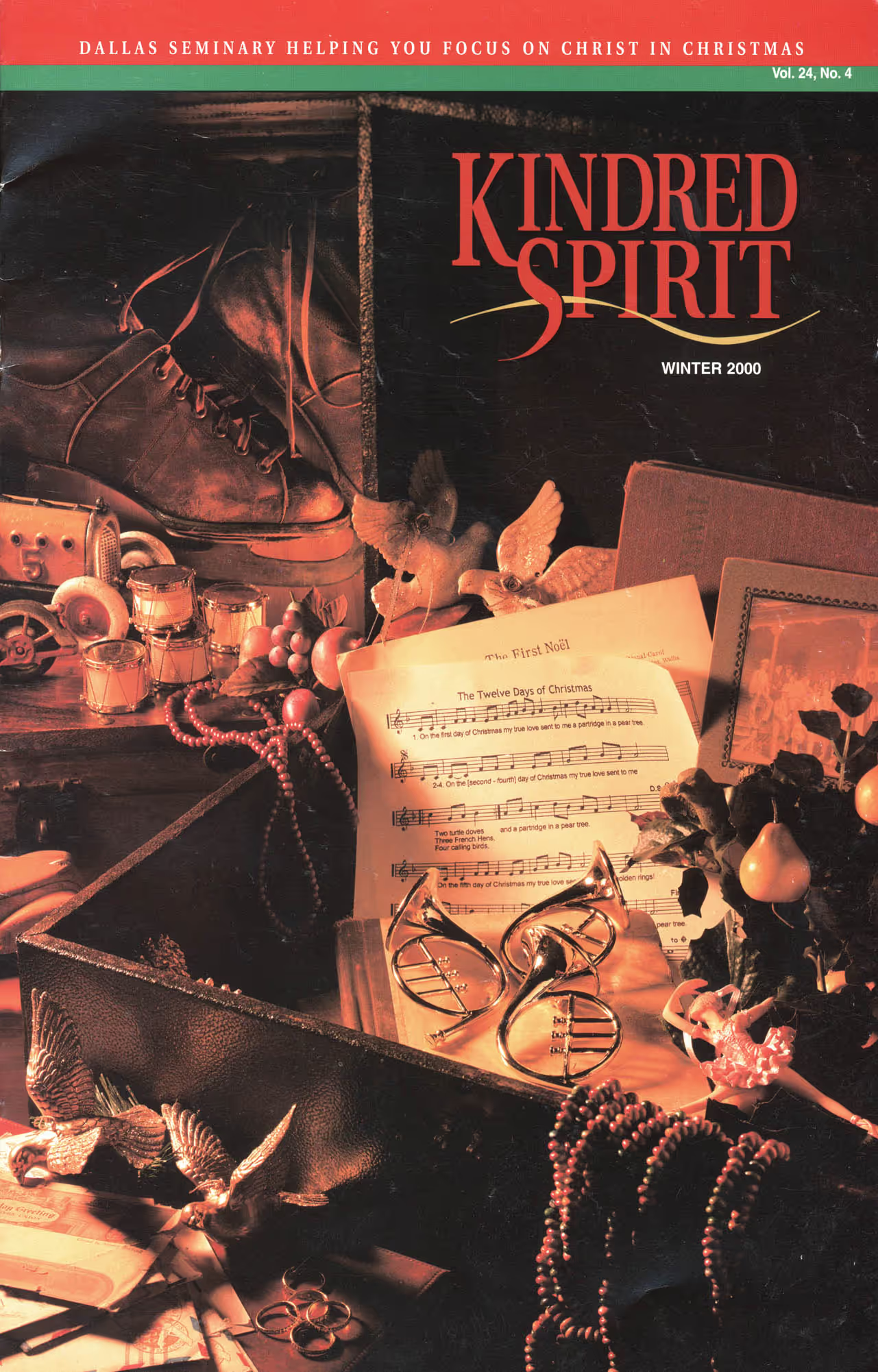
Then I grew older (and more spiritually intense). The song became another secular mockery of sacred themes. It joined my collection of Yuletide debris discarded in an attic steamer trunk. But in the past few years rummaging through my memories, I found the chest with its song inside just as I’d left it.
I think I was wrong. I’ve missed a most wonderful gift, wrapped and given to me by those who followed Jesus before me.
Who wrote it? No one knows. But it’s been around for a long time. Although I couldn’t speak to its author, I could start with two facts. First, the twelve days are the period between the differing celebrations of Christmas—December 25 (in the Western Church) and January 6 (in the Eastern Church).
Second, people living when it was written commonly wrote, painted, and thought using symbols to express what they meant. All those birds and people are probably much more than they seem. (It certainly isn’t a coded list of significant biblical numbers. That probably confuses it with a similar song called “In Those Twelve Days.”) So I started looking. Here’s what I found.
In the Middle Ages birds symbolized human beings, and each bird had specific associations. But the birds in the song had interesting Christian connections.
- The partridge was always associated with Jesus’ birth. More than that, so was the pear tree. So the song begins with a double-image of the Nativity.
- Since I’m thinking of Jesus’ birth, “two turtle doves” brings to mind Jesus’ presentation at Mary’s purification (Luke 2:21–24), and the Spirit’s descent on Him after His baptism at the start of His public ministry (3:21–22).
- “French hens,” symbols of self-sacrifice and care, are reminiscent of Jesus’ role as the Good Shepherd to His own while He was among them.
- “Calling birds”? One author suggested it might originally be “colley birds,” that is, blackbirds. (Unfortunately I haven’t found anything on their symbolism . . . yet.)
- Since it’s Christmas, the “five gold rings” aren’t jewelry. Instead they remind us of golden ring-necked pheasants which were often associated with Nativity scenes (as can be seen in Fra Angelico’s Nativity) as well as royalty (suggesting Jesus’ messianic role) and the promise of life that rises from the ashes of death.
- “Geese” (whether white or gray) symbolized spiritual vigilance, avoidance of worldly pleasures, and wholehearted devotion to godly obedience. Sounds like Jesus again.
- “Seven swans” bring the opening series to a climax. The swan, always associated with royalty and prophecy, was thought to know the hour of its death and to announce it with a great cry (“swan song”), thereby earning an enduring association with Christ’s work on the cross. Add the biblical nuance of seven suggesting a completed work, and the connection to the cross is complete. If I’d lived five hundred years ago, singing the first seven verses would have been a powerful reminder of my Savior, His life, and His work!
As anyone who sings this song knows, from here on you have to fasten your seatbelt! Momentum escalates with the last five gifts—all people. Lowly “milk maids” at work give way to dancing “ladies” and “lords” in ever-increasing displays of joy, followed by an orchestra of “pipers” and “drummers” to support the chorus, and rehearsed at a speed that carries me along in its grand celebration. What a wonderful way to celebrate the coming of our Savior! Then I got out my calculator. How many gifts were there? If one gift arrives on the first day, three on the second, six on the third, and so forth, by the last day there’s a grand total of 364 gifts. That’s one for every day of the year (using a calendar from the 1500s)!
Now at last I understand. “My True Love” is no mere earthly lover; He is the heavenly Father. The gift of His Son is sufficient for every day of the year.
The irony? Everyone, even my fellow Christians, think it’s only a secular song. They even enjoy the singing of its parodies—like “The Twelve Days after Christmas”—to mock the corruption of the holiday. They don’t understand why I can’t laugh and sing it with them anymore.
No, I don’t expect to hear “The Twelve Days of Christmas” in a Sunday worship service this season. That’s not where it was created or where it belongs. Instead listen for my voice some July afternoon, ringing out from a hot car or crowded street corner, celebrating the profound work of our Savior and the joy of His presence—a presence that fills my heart every day of the year!
About the Contributors