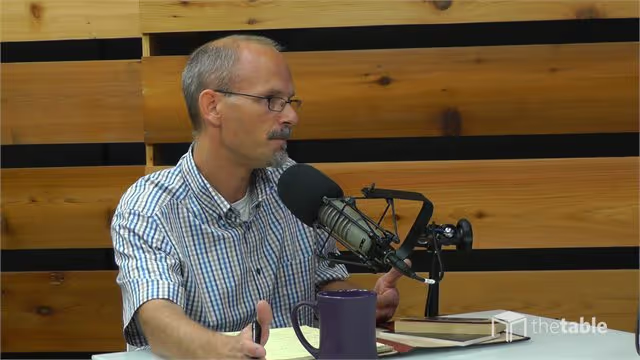
Commanding Influence
Col. Don Thompson, MD, (MA/CM, 2005) draws on training received at Dallas Seminary as he advises top members of the U.S. government on bioterrorism preparedness.
Between dissuading unmarried Air Force cadets from sexual activity,
encouraging consensus between discordant federal agencies, and
translating the gospel for patients overseas, Col. Donald M. Thompson,
MD (MA/CM, 2005), could consider himself a communications expert.
He doesn’t.
Ina Dallas Seminary class required for his recently completed master’sdegree in cross-cultural ministries, Don remembers listening ruefullyas Dr. Mark Young described critical factors in measuring communicationcompetence.
“Itjust nailed me to the wall,” Don confesses. “I’d been having somerelationship struggles, and the critical communication factors showedhow much I still needed to grow. I winced as I evaluated myself on keycommunication factors such as showing respect and positive regard forothers, understanding the issues with which the other person isdealing, tolerating ambiguity, and responding to others in a way thatis not critical, evaluative, or judgmental. I just realized howresponsible I am for the problems I have in communicating with others.”
Don’s wife of twenty-six years, Miriam, reflects on that revelation.
“Iused to think that residency was the greatest test of communication inour marriage,” she observes. “Some of the other couples in ourresidency program dropped out, divorced, or had an affair. Now I haveto say that the greatest test of communication in our marriage was theeight years in seminary.”
After Don took Dr. Young’s course,however, Miriam recalls that “communication suddenly improved likenight and day. That class changed him.”
Bridging gaps
Discerninga need to bridge communication gaps actually prompted Don to enroll atthe Seminary. While serving in Albania on one of his first medicalmission trips, Don and his group encountered an Italian-speaking Muslimphysician who expressed a personal interest in spiritual matters.Though he spoke fluent Italian, Don found himself searchingfrenetically for the right response. Finally Don’s more experiencedmedical mission colleagues intervened and provided succinctanswers—using Don as the interpreter.
“I made the decision at thatpoint,” Don recalls, “to try to become more conversant in scripturalmatters. I wanted to always be prepared to give a gentle, reverentdefense for the hope that is in me. This led me to DTS eight years ago.”
AttendingDTS meant logging thousands of miles on the road and in the air, firstshuttling between one of DTS’s extension sites and Brooks Air Forcebase, both in San Antonio, in 1996; later between DTS’s main campus inDallas and Peterson Air Force Base in Colorado in 2000, where he servedat the North American Aerospace Defense Command (NORAD); and finallybetween DTS and his current home near
Washington, DC.
Newlin Morgan,a friend at Fourth Presbyterian Church in Bethesda, Maryland, where theThompson family attends, observes, “Commuting between the Washington,DC, area and Dallas for his seminary classes was a challenge that mostwould find daunting, but Don, with the support of his family, somehowwas able to do it. Don is a solid man of God. We’ve talked about how hefelt God’s calling to equip himself better to communicate the gospel invarious cultures. As I’ve gotten to know him better, I continue to beimpressed with his gentle, humble nature and also with his willingnessto do whatever it takes to follow God’s leading.”
Helping others
Alicensed physician and a colonel in the U.S. Air Force, Donserves as senior research fellow at the Center for Technology andNational Security Policy, a division of the National Defense Universityin Washington, DC. He traces his life’s mission of helping andprotecting others back to high school.
“I got my start in helpingothers in tenth grade,” he recalls, “when I became a volunteerfirefighter and Emergency Medical Technician. I spent a lot of time inhigh school with volunteer firemen who regularly put their lives atrisk.”
After graduating from the University of Maryland with adegree in zoology, Don decided to help others through medicine. “I wentinto medicine to serve my fellow man,” he relates, “to meet bothphysical and spiritual needs.”
Don graduated with his MD from theUniformed Services University of the Health Sciences in Bethesda,Maryland. He obtained board certification in family medicine and ingeneral preventive medicine and public health. His first tour of dutyat Aviano Air Base in Italy quickly baptized him into cross-culturalchallenges.
“Americans and Italians see the practice of medicinevery differently in terms of pain and the power distance between thedoctor and the patient,” Don explains. “We Americans are trained tomake every effort to alleviate pain with medications, while Italiansfeel that a little pain and suffering is good for the soul. I rememberhaving to sneak in pain medications to a patient with fractured ribsand a chest tube just so he could get enough pain relief to breathe!”
Confronting threats
Subsequentlystationed at Brooks Air Force Base in San Antonio, Texas, Don developedthe disease surveillance process for deployed forces. He then took upan assignment at the U.S. Air Force Academy as deputy commander of theCadet Clinic.
“I worked on improving the health status of cadets,”Don notes, “focusing on reducing risky behaviors with sex and alcoholand substance abuse. We were witnessing an alarming increase inunwanted pregnancies, sexually transmitted diseases, date rape, andsexual assaults.”
Transferred after September 11, 2001, to theSurgeon’s Office at the new U.S. Northern Command and NORAD, Don’smission of protecting others shifted to bioterrorism preparedness.
Atboth NORAD and his subsequent assignment to the Center for Technologyand National Security Policy at the National Defense University, Donsays he has focused on “tackling the challenging communication andcoordination barriers that exist between federal agencies and state,local, private sector, and nongovernmental organizations.”
Afast-spreading disease such as the plague, introduced by bioterrorists,could quickly overwhelm the capacity of U.S. health facilities.Communication and cooperation would spell the difference between lifeand death for potentially millions of Americans.
“The greatestneed in homeland security right now,” Don urges, “is coordinatedresponse planning and exercising that includes local, state, federal,private sector, volunteer, and nongovernmental organizations.
Engaging churches
“Ithink churches will play a major role in communication with theirmembers. Churches provide a network of support to those in need and areideally positioned to provide this support in the midst of acatastrophe.”
Church leaders, Don asserts, “should familiarizethemselves with the most appropriate actions to be taken in the eventof a terrorist attack or natural disaster. Congregations will depend onpastors to help shepherd them through these crises. Now it is the timeto prepare” (www.christianemergencynetwork.com).
Donnotes that his DTS courses “are already being useful in my militaryresponsibilities. I was recently invited to speak at a seminar forsenior military officers at the National Defense University. So Ipresented a lecture on the intricacies of effective cross-culturalcommunication in a seminar entitled ‘Pearls, Perils, and Pitfalls inInternational Humanitarian Assistance.’”
Pursuing missions
As Don heads toward the close of his military career, his thoughts are turning overseas—to pursue a lifelong dream.
“I’vebeen interested in medical missions since high school. My first on-siteexposure to missions came in a two-week medical missions trip to Vlore,Albania, while I was stationed in Italy. I witnessed so clearly how Godovercomes obstacles thrown up by Satan—from getting medications throughcustoms to the powerful lifestyle witness of medical service.”
That first mission lit the fire for Don.
“Sincethen, I’ve participated in five short-term medical trips to Hondurasand Mexico in the past ten years, and have taken my wife or childrenalong on most of them. I like to go with Global Health Outreach(GHO)—the medical missions arm of the Christian MedicalAssociation—because GHO links healthcare delivery with local churchministry. These churches provide manpower support to the medical team,but most importantly, evangelism and discipleship of new converts.
“Iplan to use my master’s degree in cross-cultural ministries moredirectly in international medical missions work when I retire from theAir Force in a few years. Currently the Lord has me in a setting whereI can effectively impact national security policy using my DTStraining. I eagerly look forward to moving into a moremissions-oriented ministry, but for now God seems to be directing metoward work in the public square.”
Jonathan Imbody, a senior policy analyst for the Christian Medical Association
( www.cmda.org ), writes for the LA Times,USA Today, and the Washington Post.
About the Contributors