
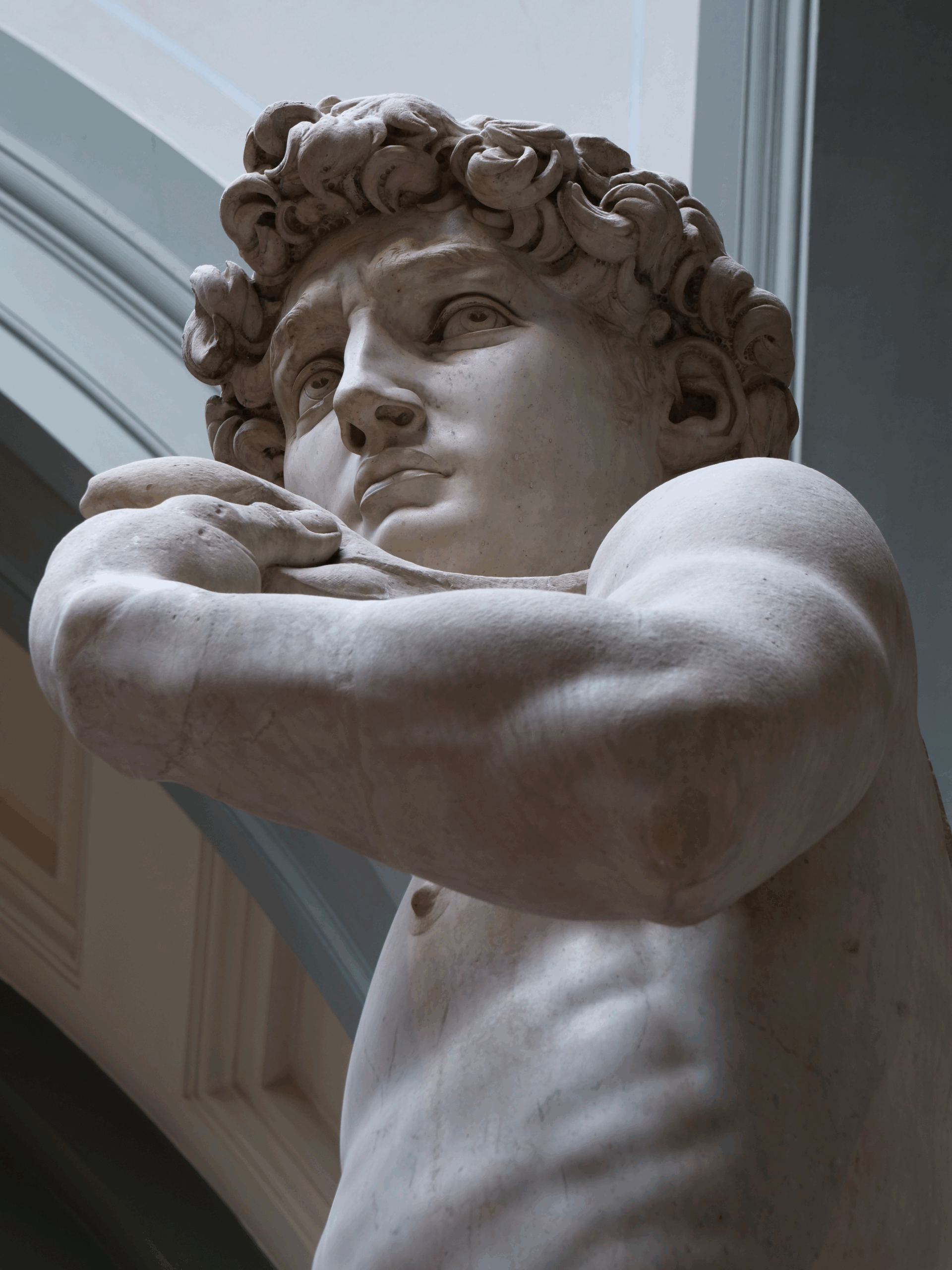
David (1501–1504), Michelangelo
Looking at an impending conflict, you can’t stop your palms from sweating, knees from quivering, and heart from sprinting as if it may dash out of your chest. Why can’t you stop yourself from shaking? You dread conflict, and so do I. That tough conversation, going in for medical treatment, facing financial strain, or navigating the toxic atmosphere at your job—how will you survive? Stress pummels you like tides under a stormy sky. Do you sometimes feel defeated in the face of confrontation? Yet we know that living well calls us to face conflicts well, because life guarantees conflicts. How do we do that?
Michelangelo’s David statue illustrates a biblical insight about facing conflicts, especially gargantuan ones. (Read 1 Samuel 17.) The city of Florence commissioned Michelangelo Buonarroti to create a symbol of Florentine pride in 1501. Completed in 1504, civic leaders proudly displayed the two-story-tall David statue in front of Palazzo Vecchio until it was moved to the Accademia Gallery. Many people through the years have replicated this masterpiece in lesser forms of images, garden decor, and souvenir tokens. The iconic piece exudes strength, confidence, and resolve, but not in the way we might expect according to a worldly understanding of power.
Michelangelo was not the first to sculpt a David statue. Donatello made one in marble in 1409 and then another in bronze in 1440. Verrocchio made one in bronze in 1475. All the sculptors portrayed David leaning on one leg, a hand by his hip, in a calm, relaxed pose. But Michelangelo’s statue exhibits one stark and brilliant difference. Unlike the others, there is no decapitated head of Goliath at his feet, meaning Michelangelo portrays David before his battle with Goliath. Whereas other sculptors showed Goliath already slain, Michelangelo shows David about to fight the giant. Well, then, what’s David doing standing calm and relaxed?
David’s physique projects power and confidence, fashioned in a classic ancient Greek style. David’s nudity celebrates the dignity and beauty of the human form. In his left hand, he holds a sling over his shoulder, as if draping a jacket while going out for a walk. Cradling a rock, his right hand hangs relaxed by his hip in a manner similar to the earlier David statues that had hand propped on hip. A difference is this David cannot prop his hand on his hip—the battle hasn’t happened yet—and so the projectile with which he will slay Goliath is still in his hand. Nonetheless, that hand relaxes by his hip.
But his face—his face exposes the power. Standing squared off, he looks over his left shoulder, staring at something in the distance, which we can assume to be Goliath. Search online for the image of this David’s face. Zoom in. See his channeled brow, furrowed forehead, and pressed lips. And those eyes! He’s not looking down or to the side with drooping eyelids. His wide-eyed, unwavering, piercing gaze reveals his focus, determination, and resolve. The juxtaposition between his relaxed, calm posture and his intense, fierce gaze at the problem before him tells us that in his spirit he has already won. “To Michelangelo, he embodied Fortitude” (Janson, 5th ed., 1997, 461). This is faith in the face of trials.
Read 1 Samuel 17:45–46 again. David declares, “I am coming against you in the name of the Lord of Heaven’s Armies, the God of Israel’s armies, whom you have defied. This very day the Lord will deliver you into my hand. . . . Then all the land will realize that Israel has a God” (NET). See this kind of faith in the face of David. Michelangelo expresses David’s faith as one who knew victory in his spirit over the problem. “The Lord will deliver” is a faith of assurance, believing wholeheartedly in what God will do before the earthly results happen. The faith of David reminds us of the definition we read in Hebrews 11:1—“Now faith is being sure of what we hope for, being convinced of what we do not see.” David hadn’t seen the victory yet, but he saw it.
David’s faith ran deep, not only in his heart but also in his past. It wasn’t only what he knew God would do in that moment, but what God had done in the past. In 1 Samuel 17:36–37, David revealed to Saul where his faith came from: “Your servant has struck down both the lion and the bear. This uncircumcised Philistine will be just like one of them, for he has defied the armies of the living God. . . . The Lord who delivered me from the lion and the bear will also deliver me from the hand of this Philistine.” David saw God’s faithfulness in past trials, and, unbeknownst to David at that time, God was preparing him then for this moment now. God does not send us into present conflicts without having prepared us through past problems. Who knew that fighting bears while watching after sheep would ready him to fight a giant in a pivotal moment to glorify God? David knew this. He knew God had prepared him for this. God showed up then, and God will show up now. We can establish our faith in God in the present on God’s faithfulness in the past.
Conflicts are hard but also normal. Looking at storytelling, Robert McKee writes that one constant we can count on in life is the reoccurrence of conflicts. There is no journey without trials. The way we face giants tests and shapes our character. Foster a faith of fortitude founded in the faithfulness of God to face your giants for the glory of God.
Questions:
- Take a sheet of paper, and at the top, write a title for a conflict you are facing. Underline it. Below that, list all the ways this conflict challenges you. In what ways is it a giant? Prayerfully, lay this before God.
- On the back the paper, draw a horizontal line across the middle. In the top half, write what faith to face the conflict means and looks like. In the bottom half, reflect on how God has been present and worked in you in past problems. What did those times reveal to you about God, and what did they teach you? In what ways did past problems positively shape you? How has all of this in the past prepared you for the present conflict? Write all this in the bottom half.
- Meet with a friend, relative, spouse, mentor, or confidant, someone who knows you well, to share about what you wrote, front and back sides. Ask if they would add anything to the bottom half of the paper. Write those down, too. Then ask that person to pray with you over your conflict.
- On your own, read 2 Corinthians 5:7. How does seeing the conflict before you through a lens of faith change the way you see it?
For more devotionals in this series, click here.
About the Contributors
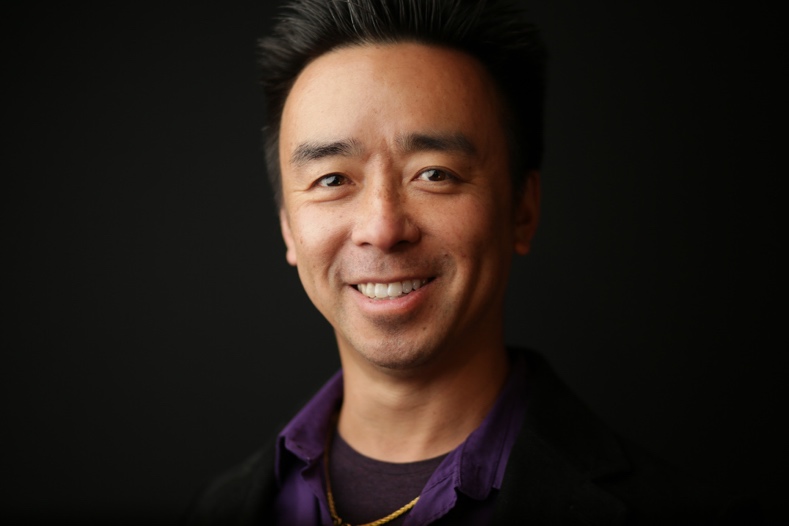
Brian S. Chan
Dr. Brian S. Chan is an assistant professor at DTS, where he teaches courses on the theology of creativity and beauty, visual artmaking, storytelling and faith, film, and creative writing. He previously pastored in Hollywood/Los Angeles and taught at Biola University, focusing on the theology of beauty, art, and film. Dr. Chan is also an internationally award-winning fine artist and serves as a workshop instructor in Hollywood. He is a board member of Lantern of the East Los Angeles International Artists.
As a certified kung fu master, Dr. Chan trained actors while in Hollywood. He authored The Purple Curtain: Living Out Beauty in Faith & Culture from a Biblical Perspective and Not Easily Broken (a novel). He is the chapter director of the Hollywood Prayer Network at DTS and mentors Christian artists in Europe through the European Leadership Forum.
Dr. Chan holds a BA in Psychology and a BA in Sociology from UC Davis, an MA in Christian Education and a ThM in Historical Theology from DTS, and a DMin in Philosophy from Talbot School of Theology. He is currently pursuing a PhD in Theology and the Arts at the University of Birmingham in the United Kingdom.
Dr. Chan lives in Frisco with his wife, Ellen, and their son, Josiah. For leisure, he enjoys tai chi in the park, creating bonsai art, collecting toys, goofing off with his son, and watching a good movie.
Contributors


