
Deaf President Now! (2025), directed by Nyle DiMarco and David Guggenheim
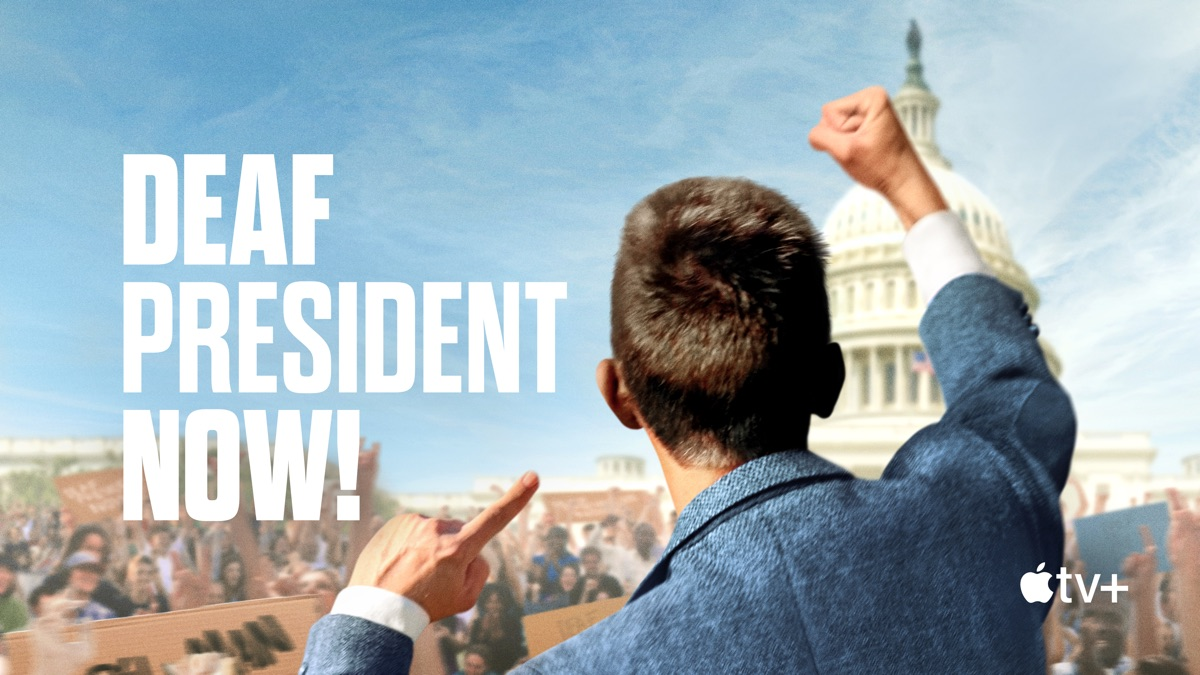
In the decades since the creation of film storytelling, society’s connection with film has grown deeper and more intimate. Filmmakers are not only entertainers of the masses but also historians of culture, creating films that both reflect and influence society. The documentary film genre has a singular power to make the world both smaller (through connection) and larger (through perspective). This was certainly the case for me when I watched Deaf President Now! at the 2025 Sundance Film Festival, a runner-up for Festival Favorite and a two-time Emmy nominee, now streaming on Apple TV+.
Deaf President Now! tells the story of the small group of students at Gallaudet University (the world’s only all-deaf school) who exercised leadership in 1988 in the midst of student protests over the hiring of a hearing college president. The board explained to the press that a deaf person was not ready to lead in a hearing world—a message that the deaf students found unacceptable, as they were attending Gallaudet to learn to do just that.
The film was codirected by Nyle DiMarco, who is deaf, and David Guggenheim, who is not. Through the directors’ unique perspectives and creativity, the audience experiences what this weeklong protest would have sounded like to both the onlookers who heard every drum, car horn, and shout, as well as the students themselves who could hear nothing. It’s a story of struggle for a minority group who are told that they are less-than and will not be afforded the right to make decisions to dictate their lives. But it’s also a story of triumph as that group perseveres peacefully to gain support, not only within their community but also in the hearing world.
The deaf community is a subculture in America that is vastly overlooked by the majority of the population. The tendency of one community to misunderstand or ignore another is so consistent throughout human history that God made provision for all people in his law: “When a resident foreigner lives with you in your land, you must not oppress him. The resident foreigner who lives with you must be to you as a native citizen among you; so you must love the foreigner as yourself, because you were foreigners in the land of Egypt. I am the Lord your God” (Lev 19:33–34).
Many have felt like “foreigners” at some point. Whether traveling to another country or walking into another family’s home in our own city, we will find ourselves unaware of the expectations. If we’ve lived in a cross-cultural situation, then we’ve felt that foreignness even more acutely. God provides for his people in uncomfortable moments by—wait for it—his people. Barriers such as language, race, and social status don’t diminish our calling to meet people’s basic needs. When a person feels hungry, that need ought to be satisfied with food. When a person feels lonely, a smile from a stranger can change that. And when a person wishes to be identified as belonging to the Lord, that is achieved by showing love (John 13:35).
If you feel uncertain how to learn to relate to the people around you, you might start with a film. As Roger Ebert famously said, “Movies are the most powerful empathy machine in all the arts, [allowing the viewer to] live somebody else’s life for a while [and] walk in somebody else’s shoes.”[1] Maybe it’s time to catch a movie and take a stroll in someone else’s shoes. I would encourage you to start with Deaf President Now!
Questions:
- Think of a time when you found yourself a foreigner. Did someone seek to care for your needs, whether physical or emotional? How did that make you feel?
- Is there someone in your world right now who would benefit from being cared for in a similar way? How might you reach out in a way that shows you want to learn and understand?
- What film has broadened your perspective on a community or culture?
- What community or culture do you wish you understood better? What films might help with that? If you are not sure, whom could you ask?
For more devotionals in this series, click here.
[1] Roger Ebert, “Ebert’s Walk of Fame Remarks,” RogerEbert.Com, December 19, 2012, https://www.rogerebert.com/roger-ebert/eberts-walk-of-fame-remarks.
About the Contributors
Contributors


