
Pickleball Evangelism
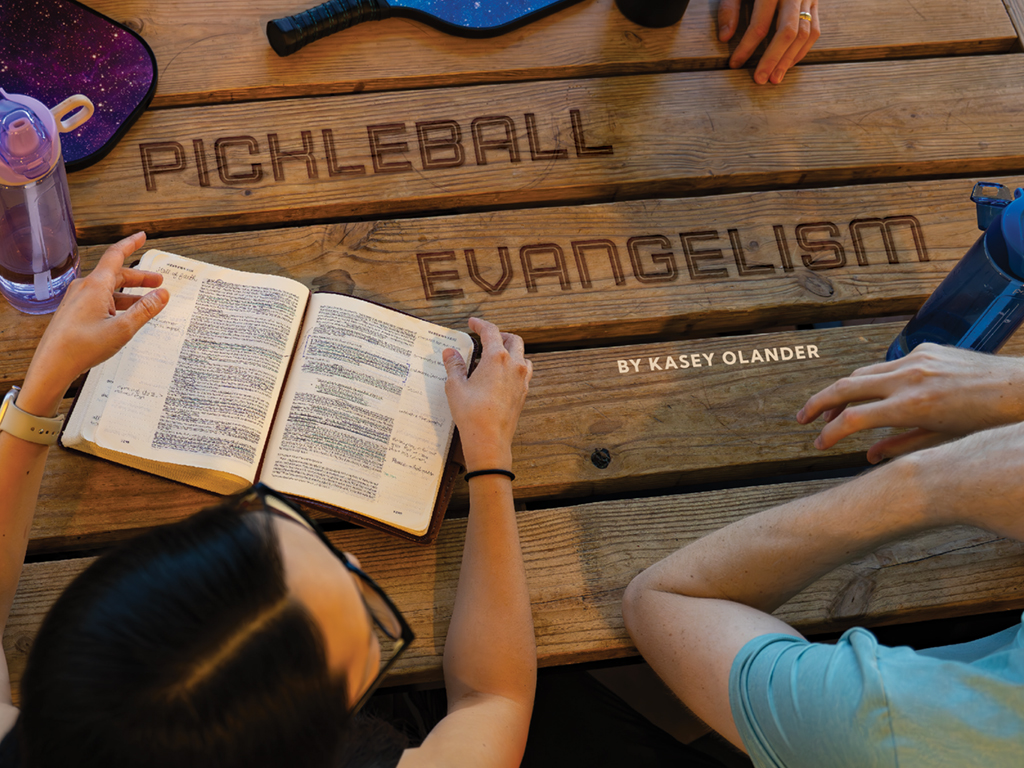
You walk in and face the other person. Who will go first? you wonder. How will I do? What if I miss an obvious opportunity? You anticipate the back-and-forth, the rhythm of the exchange. The expectancy swirls within you as you cannot predict exactly what will unfold, and the stakes rise as it all begins.
I often feel these conflicting and complementary emotions when I step onto the pickleball court. And I experience a similar mix as I enter a spiritual conversation. Engaging in community pickleball matches has not only brought opportunities to share Christ, but it has also shown me a lot about the connections I seek to build with others in any spiritually focused encounters.
My husband, Daniel, and I belong to two communities: the DTS student population and fellow novice pickleball enthusiasts. Pickleball represents my first foray into the world of sports—and it shows. Thankfully, the welcome of a gracious bunch of pickleball players has provided opportunities to get to know them and share Christ. Our experiences in pickleball illustrate timeless truths about evangelism. First, the way we live affects our opportunities to share the gospel. Second, evangelism most often occurs in community with our brothers and sisters. Third, the way we approach spiritual conversations carries great significance. For believers, any location might supply the chance to teach truth and love well . . . even the sweaty sidelines of a local gym.
Evangelism Includes Conduct
Corbin1 arrived late one evening, joining the end of a long line of waiting pickleball players. Daniel immediately offered his own spot in the next game to Corbin, relegating himself to the back of the line instead. It must have made an impression, because weeks later, Corbin mentioned Daniel’s self-sacrificial gesture to me. I found myself unprepared for what in hindsight seems so obvious an opportunity for a spiritual conversation. Although sacrifice and love of neighbor easily point to Jesus, I dropped the ball (metaphorically) on that occasion. Disappointed in my missed opportunity to direct Corbin’s attention to Jesus, I mused on what I should have said—Christians love because God first loved us (1 John 4:19). Despite my lackluster interaction, Daniel’s selfless act meant something to Corbin.
We evangelize not only with our words but also with our conduct. The behavior of a Christian connects inextricably to their witness to Christ. Others listen to our lives just as much as they listen to our speech. Whether consciously or unconsciously, those around us observe the way we interact in the world. Do we follow through on our word? Do we ooze kindness and gentleness? Do we radiate certainty that Christ reigns as our unfailing king? Jesus urges his followers, “let your light shine before people, so that they can see your good deeds and give honor to your Father in heaven” (Matt 5:16). Our good conduct can cause people to look to God.
Evangelism Incorporates Community
Daniel’s consistent kindheartedness causes others to take notice. After one of our pickleball games, Cathy said, “Daniel is the sweetest guy—is he always that way?” Because I’d missed my chance in the earlier conversation with Corbin, and because she genuinely inquired, I straightforwardly responded by informing her that Daniel’s kindness stems from love for Jesus. Cathy immediately asked for further explanation. “Really? It’s because he loves Jesus? Tell me more about that.” Surprised but pleased, I eagerly shared that I had witnessed firsthand the transformative power of Jesus in his life. Her eyes locked onto mine as she listened intently, so I thoroughly shared the gospel with Cathy. It turned out that another conversation the day before had primed her to talk about spiritual matters. She came prepared with questions for me about what Christians believe, and she shared some of her own story. In a robust dialogue, Cathy and I covered a lot of ground, discussing the problem of evil, the nature of human dignity, and how Jesus changes a person’s entire life.
Meanwhile, our friend Katherine, another DTS student, overheard my conversation with Cathy and began praying. She eagerly followed up with me afterward, excited and prayerful for Cathy to follow Jesus. Daniel’s demeanor caused Cathy to notice something distinctive about him. I verbalized the gospel message that had transformed Daniel. And Katherine interceded on our behalf during the interaction.
Our evangelistic efforts depend on community. A person may experience different facets of Jesus through our brothers and sisters. As believers, we each have unique giftings, opportunities, and people with whom we have natural rapport. God graciously lavishes these upon us that we may obey the two greatest commandments— love of God and love of our neighbor. Paul employs a horticultural metaphor to describe the ways we can contribute to another’s spiritual growth. He reminds us that “neither the one who plants counts for anything, nor the one who waters, but God who causes the growth” (1 Cor 3:7). We delight for God to use us for his glory, not for our own renown.
Evangelism Involves Conversation
Over many pickleball games, I built a friendship with Paul, who knew about my faith. Out of the blue one Saturday, Paul asked my opinion on a romantic relationship that raised moral questions. He shared a story of his interactions with someone and their mutual interest in one another, and then he asked me directly, “So what do you believe about incorporating faith into life?” In other words, does faith in God have anything to do with our relationships?
Prayerfully and cautiously, I knew I had to tell Paul the truth about Christianity and exactly what it costs. Although Paul may not have wanted to hear it, the truth honors candid questions. I wanted to develop a safe environment that meant he could trust me with his honest thoughts, while simultaneously conveying what it means to follow Jesus. I gently shared that following Jesus means laying down one’s entire life, even when it feels difficult. Much more than a Sunday morning endeavor, trusting Jesus affects every relationship, interaction, and decision, seen and unseen. The Holy Spirit indwells believers and enables us to follow Jesus Christ with our lives.
In the end, the difficult conversation I’d feared became a robust opportunity to share what discipleship looks like. Our conversations have continued, and Paul has gratefully accepted recommended resources. I thank God for the opportunity to invest in Paul and other pickleball players on and off the court.
Evangelism involves our conduct, community, and conversation. Our individual and group actions matter; our verbal interactions with a nonbeliever carry weight, too. Paul again urges the church, “Let your speech always be gracious, seasoned with salt, so that you may know how you should answer everyone” (Col 4:6). Our speech requires grace, not merely correctness. Each of my conversations on the pickleball court began because of observable kindness. The conversations comprised the words spoken and the manner in which the believers engaged in the exchange.
My pickleball career has been illustrative, if not illustrious. Evangelism includes conduct. The way we live and interact with others shapes our witness to Christ’s love. Evangelism incorporates community. One believer’s behavior may open an opportunity for conversation, which another believer participates in, while still another believer prays. Evangelism involves conversation. The way a believer approaches the conversation matters in the same way the content matters. As Christians, our lives together as we share the transforming work of Christ bring opportunities to respond to the Lord’s call to make disciples. We can share the gospel and experience formation as evangelists anywhere—even between games of pickleball.
1 Names are changed throughout this article.
Read more from Kasey about the theology of pickleball.
About the Contributors

Kasey Olander
Kasey Olander works as the Web Content Specialist at The Hendricks Center at DTS. Originally from the Houston area, she graduated from The University of Texas at Dallas with a bachelor’s degree in Arts & Technology. She served on staff with the Baptist Student Ministry, working with college students at UT Dallas and Rice University, particularly focusing on discipleship and evangelism training. In her spare time, she enjoys reading, having interesting conversations, and spending time with her husband.
Contributors


