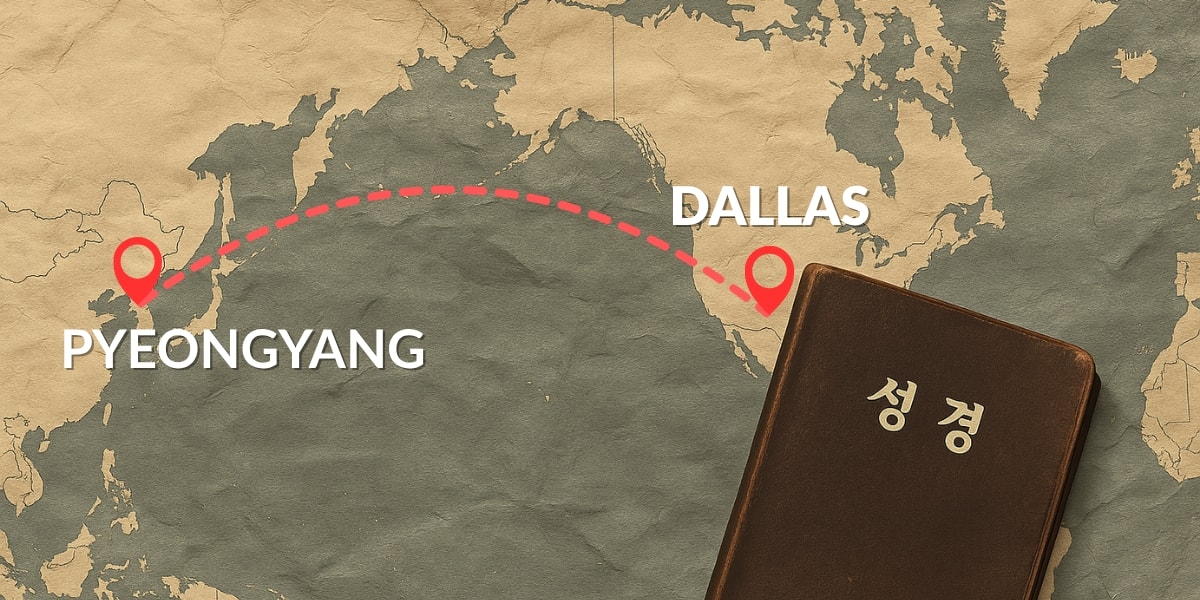
From Pyeongyang to Dallas
The Story of Kim Seung Lak (ThD, 1931), Dallas Theological Seminary’s First Korean Graduate
During Dallas Theological Seminary’s centennial celebration in 2024, excitement also stirred on the other side of the globe. In Korea, a group of alumni gathered in a group chat to plan a reunion in Incheon, coinciding with a visit from seminary staff attending the Lausanne Congress. The Korean graduates exchanged greetings and personal news. As they reminisced about their time at the seminary, one graduate shared images from a decades-old alumni directory. Among the pages appeared a significant name: Reverend Seung Lak Kim (Sung Nak or Shungnak Kim), the first Korean graduate of DTS, who earned his ThD in 1931, when the school was still known as the Evangelical Theological College (ETC).
Inspired by this remarkable discovery, one curious alum reached out to the seminary’s librarian, who unearthed a trove of documents detailing the life of this early graduate. Among the materials was a letter written by Seung Lak Kim in the winter of 1930, addressed to Rollin Thomas Chafer, the registrar and elder brother of the seminary’s founder, Lewis Sperry Chafer.
My dear Dr. Chafer:
Perhaps you are wondering where I am staying in this year. Since I last wrote you, I was waiting to get my good health till this month. Fortunately I am getting very well now. During few months, I was taking some courses at Yale because I am staying in New Haven. I want to study at Evangelical Theological (Seminary) College from this second semester. If I do not study at there, I will waste time this year. I wish you accept me as your student from this term. I am planning to go back home soon as possible. I am waiting your letter or telegram. (I am very glad that I have good health again.)
…
I believe that God always lead my way in His will, therefore, I am happy to work as He shows the way.
Sincerely yours,
Seung Lak Kim
That correspondence provides a bit of background to Kim’s arrival at DTS. But who was this man, and how did he come to ETC? Seung Lak Kim was a colonial citizen of Japan, which had annexed the Korean peninsula in 1910 and maintained colonial rule until 1945. He came from Pyongyang, a city later known as the “Jerusalem of the East” following the landmark revival of 1907. Kim attended Soongsil School, a Christian secondary institution founded in 1897 by missionary W. M. Baird. Later ratified as Union Christian College, the school became the first institution of higher education officially recognized by the Japanese colonial administration. Kim earned his bachelor’s degree from this college and a master’s degree from the college’s seminary, known as Union Theological Seminary (also referred to as Pyongyang Seminary). His theological education in the United States appears to have been encouraged by the missionaries who taught there. In 1929, Kim completed a ThM at Princeton Theological Seminary before eventually continuing his studies at ETC.


What compelled Kim to pursue further studies at ETC rather than continue at Princeton, where he had completed a ThM, or Yale, where he had taken a semester of coursework? Letters exchanged between the Chafer brothers reveal a possible reason: Princeton had not granted him admission to a doctoral program. In July 1930, Rollin Chafer wrote to his brother Lewis, discussing Kim’s application and the circumstances surrounding it.
Dear Lew,
…
Now about Kim’s papers. We must go ahead on the fact that Princeton gave him the Th.M. They cannot criticize us for giving a degree if they did. I do not know the valuation of the group system at Princeton. I note quite a percentage of his grades are in the 3rd and 4th groups. I imagine that 1st group is highest standing—our A or A+; second group, B or B+; third group, C or C+; and fourth group, D or D+. Wick will be able to give you the grading system. He has completed the residence requirements, by two postgraduate years at Princeton, and the partial year at Yale. I would advise giving him the Th.D. if he can get in his thesis, and take special work under you and get into the Bible classes as much as possible. Without knowing his plans as to thesis I did not dare place him in the catalog for this year, but that makes no difference, for the change will be made in the catalogue record of commencement exercise in next catalog.
…
Love, 2 2 3,
RTC.
The letter reveals the Chafer brothers’ decision not only to accept Kim but also to confer upon him the Doctor of Theology degree. Remarkably, it appears Kim was granted the extraordinary privilege of graduating with the ThD after just one semester at ETC. Following Kim’s arrival on campus, Lewis wrote to Rollin:
My dear Rollin:
I am enclosing herein all of the credits on Seung Lak Kim. Mr. Kim got in last night and is being located this morning. It seemed there was nothing more to to be done than to give him an exact duplication of Dr. Glover’s schedule, which, apparently is not only fitting but satisfactory. Kim has his master’s work from Princeton. On top of this he has done an extra year at Princeton and the fall semester of this year at Yale. It seems he has sufficient credits so that if he does the work here of the spring semester, he would be entitled to be through at Commencement time though probably he would not have completed his thesis. The hurry in his case is about as commendable as in the case of Glover. Kim has an opportunity to begin teaching theology next fall in the Korean Theological Seminary and of course if he remains here through the summer and fall that service would be postponed a year if not permanently. In case he is to be favored thus it would be necessary, I suppose, as with Dr. Glover, to secure a special vote from the faculty allowing him this particular privilege…
As ever, yours,
Lew
In May 1931, Seung Lak Kim graduated from ETC as one of four recipients of the ThD degree, alongside three diploma recipients, six ThB graduates, and four ThM graduates. As a result of his special work under Lewis Sperry Chafer, Kim appears to have completed his dissertation—titled “Pneumatology”—within a single semester. His name is listed beneath that of “Dr. Glover,” another international student from Winnipeg, Manitoba, Canada.


These century-old records surrounding Seung Lak Kim reveal his deep resolve to attend ETC above all other possible options.
In his application to ETC, Kim responded to the following questions:
Question 12: So far as you know your own heart, are you willing to do the will of God when you know His will for you?
Kim’s Answer: Yes, that is why I am preparing and leaving home and studying in America far away.Question 19: What has inclined you to consider the Evangelical Theological College of Dallas for your ministerial training?
Kim’s Answer: I want to know your method . . . (biblical doctrine)
Evangelical Theological College marked a pivotal juncture in Kim’s journey; it was a place where his calling to pursue “the will of God” through academic preparation reached its fulfillment. Under the guidance of the Chafer brothers—Rollin, who trusted Kim’s ability to complete the rigorous academic work, and Lewis, who supervised his dissertation—Kim’s time at ETC culminated in a momentous decision. Together, they conferred a degree that may well have shaped the future of the Korean Church.
Seung Lak Kim returned to Pyongyang and taught at his alma mater, Union Theological Seminary (later Soongsil University), from 1934 to 1937, before the Japanese government forced its closure in 1938. As Japan intensified its enforcement of emperor worship, Kim left Korea and returned to the United States—this time as an immigrant—along with his wife and four children. He became the second senior pastor of the Korean Presbyterian Church of Los Angeles, the second Korean immigrant church in the US, founded in 1907.


Following Korea’s liberation and the devastation of the Korean War, Kim returned to South Korea, where he became president of the reestablished Soongsil University in 1954. In 1981, Reverend Kim became the first Christian leader to visit communist North Korea at the invitation of its leader, Kim Il-Sung, whose father had attended the same Christian secondary school (Soongsil School) as Reverend Kim. During a subsequent visit to Pyongyang, Reverend Kim brought with him 200 Bibles, which played a key role in the establishment of Bongsu Church and Chilgol Church—the two officially recognized churches in North Korea to this day. Until the end of his life in 1989, he faithfully preached and prayed for the peaceful reunification of Korea.

Kim Seung Lak’s acceptance into and graduation from Dallas Theological Seminary—just seven years after its founding—as one of its earliest international students and the first known graduate from the continent of Asia, stands as a powerful witness to the seminary’s early commitment to God’s global mission. His story is a remarkable testimony of grace, embodied in the vision of Rollin and Lewis Sperry Chafer, who recognized the calling and potential of this godly man from Pyongyang. They saw beyond what transcripts from Princeton could fully capture and entrusted him to return home equipped for gospel ministry.
Nearly a century later, as DTS continues to pursue God’s global mission, we find ourselves in a fitting moment to rediscover and honor the legacy of our first Korean graduate. Seung Lak Kim’s courageous journey—from Pyongyang to Dallas, in obedience to God’s will—left a lasting influence on the church in his homeland. Remarkably, through Kim, DTS became linked to the early development of theological education in Korea under Japanese occupation, the postwar restoration of Christian higher education in South Korea, the founding of the Korean immigrant church in the United States, and even the establishment of the first officially recognized church in communist North Korea. As we remember this legacy, may we be faithful to lift up the Korean people and peninsula in our prayers, that the two Koreas will reunify, and the divided churches will be made one.
The photos in this article has been provided by Dallas Theological Seminary Archives and University of Southern California Digital Library
About the Contributors

Ahrum Yoo
Ahrum Yoo is a PhD student in Old Testament at Dallas Theological Seminary, where she also earned her ThM. After receiving the Lord’s call, she served as a missionary and was later led to pursue theological education. Prior to ministry, she studied economics and public policy and worked as a management consultant in Japan and Korea. Ahrum’s vision is to bring sound, Bible-based theology to the mission field. She is also passionate about connecting Old Testament theology with public issues such as governance, justice, and ethics. Ahrum is married to Davis, and together they have five children.
Contributors


