
“It Is Finished” (1994), James MacMillan
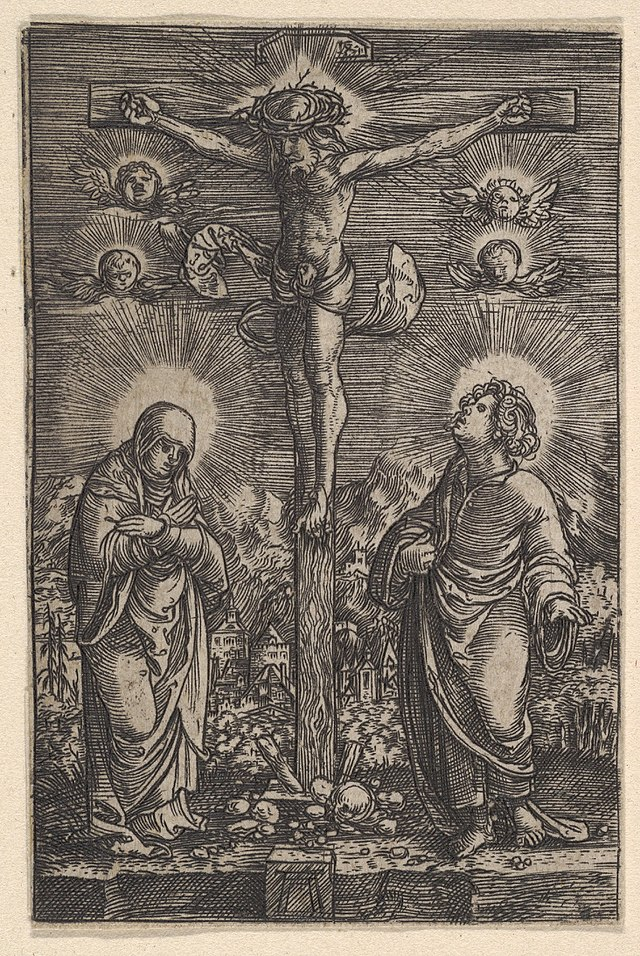
God affirmed creation as good, and he reveals himself to us through the creation itself (Rom 1:20), his revealed Word, and most fully in the incarnation of his Son. This suggests that knowing him is not a matter of words alone; rather, he invites us to know him through our senses—including through artistic expression. I always think of this especially as we approach the pinnacle of the church year, Easter Sunday. In the week leading up to that glorious day, congregations may choose to gather for times of special reflection on the Passion—Maundy Thursday, Good Friday, and Holy Saturday (or Easter Vigil). In those moments, feeling the weight of Jesus’s suffering and death, we read the Gospel accounts, but we also draw on our senses to imagine ourselves in those days that, for Jesus’s followers, were dark and confusing. We sit together in a church sanctuary that’s darkened. Our singing might take on a more subdued, somber tone. Décor and objects at the front of the church are removed, leaving an empty space. Silence becomes an important “color” to paint with, so that we can once more confront the agony of our Lord that led to the triumph of the Resurrection.
One musical tradition that has developed as a way of further contemplating the events of Holy Week is setting the “seven last words of Christ on the cross” to music (the order can vary):
- “Father, forgive them, for they do not know what they are doing.” (Luke 23:34)
- “Woman, look, here is your son! . . . Look, here is your mother!” (John 19:26–27)
- “I tell you the truth, today you will be with me in paradise.” (Luke 23:43)
- “Eli, Eli, lema sabachthani!” (Matt 27:46; Mark 15:34)
- “I am thirsty!” (John 19:28)
- “It is completed!” (John 19:30)
- “Father, into your hands I commit my spirit!” (Luke 23:46)
I appreciate Scottish composer James MacMillan’s setting in his Seven Last Words from the Cross. Let’s look at the sixth section, “It is finished,” and consider the way the polyphony of music and text in a modern classical work can draw us into the story.
The movement opens with violent, attacking notes in the string orchestra—perhaps making us think of the nails being pounded into Jesus’s hands and feet. Then the sopranos begin singing from Lamentations 1–2, a text traditionally read on Good Friday:
My eyes were blind with weeping, [2:11]
For he that consoled me is far from me:
Consider all you people,
is there any sorrow like my sorrow?
All you who pass along this way take heed
and consider if there is any sorrow like mine. [1:12]
Underneath those words, the other voices repeatedly intone, “It is finished.” In bringing these texts together, MacMillan expands that moment on the cross to build a bridge back to the Old Testament. The Israelites lamented their transgressions that had brought them to a point of separation and destruction. In the music, their words travel across time to suggest two connections to Jesus. First, he is at that moment the human who can rightly ask, “Is there any sorrow like mine?” We see him bearing the full weight of the world’s despair. Then we discover a second meaning: The work of Jesus on the cross reaches back through time to answer the longing of Lamentations. Is there any answer to eyes “blind with weeping”? The answer is Jesus himself. He alone can resolve the yearning and lament of our fallen nature.
The movement closes with a return of the orchestral attacks. It’s as if these few minutes of music have stopped time and revealed something about the continuous story of Scripture. But now the work of the cross must continue and take us on to the Resurrection.
Questions:
- Read the account of the crucifixion in one of the Gospels (Matt 27:26–66; Mark 15:15–47; Luke 23:24–56; John 19:16–42). As you read, allow time to expand one moment of the account. What senses are most important to understand that moment?
- What yearnings or struggles do you face today? Can you look to Jesus as the answer, even in the midst of sorrow?
- What other hymns or songs do you know that invite you to expand a moment and discover connections across the story of Scripture?
- How might you incorporate music into your daily times with the Lord?
For more devotionals in this series, click here.
About the Contributors

Neil R. Coulter
Neil R. Coulter completed degrees in music performance and ethnomusicology from Wheaton College and Kent State University. He and his family lived in Papua New Guinea for twelve years, where Neil served as an ethnomusicology and arts consultant for Wycliffe Bible Translators. In 2015, he helped design and launch the PhD in World Arts at Dallas International University. He teaches doctoral courses in theory and ethnography at DIU’s Center for Excellence in World Arts. At DTS, he teaches about art, literature, film, and theology, and he is senior writer and editor of DTS Magazine. Neil is married to Joyce, and they have three sons.
Contributors


